The Enlightenment Portfolio: Where Investing Meets Spirituality and Silicon Valley
TL;DR
Sam Prentice examines what happens when venture capital, AI, and spirituality converge into an investable sector. Temples accepting crypto, venture-backed guru apps, and AI-guided spiritual products are already here, and the piece lays out the questions investors should ask before allocating, along with the ethical weight of the returns.
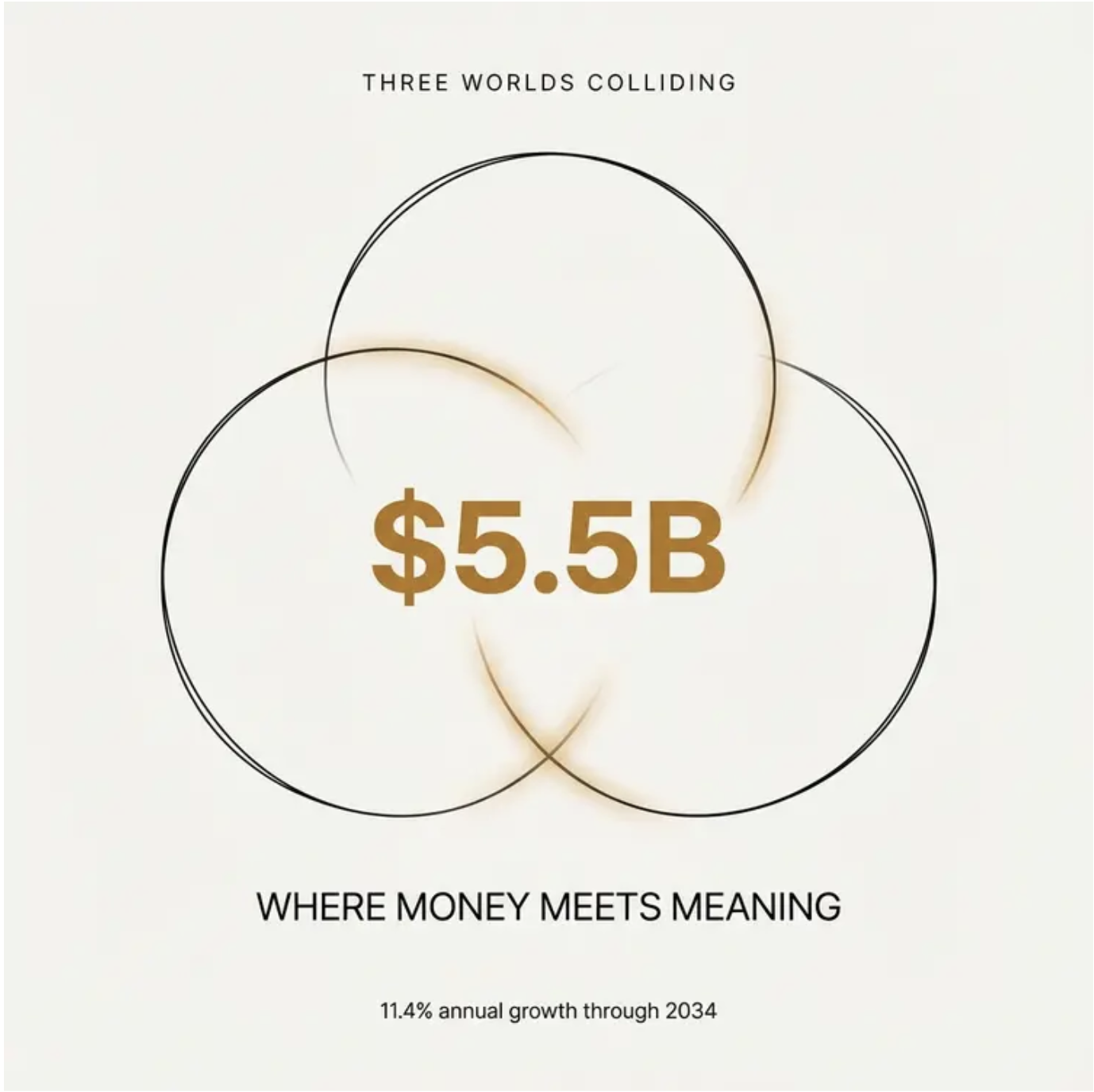
I've been watching something strange happen at the intersection of three worlds that aren't supposed to touch.
Investing. Spirituality. Technology.
The walls between them are dissolving faster than anyone predicted. And the result looks nothing like what the mystics or the venture capitalists expected. Capital is flowing into consciousness. Algorithms are pricing enlightenment. And some of the smartest money in tech is betting billions that the future of investing is spiritual as well as financial.
The Investment Thesis Nobody Saw Coming
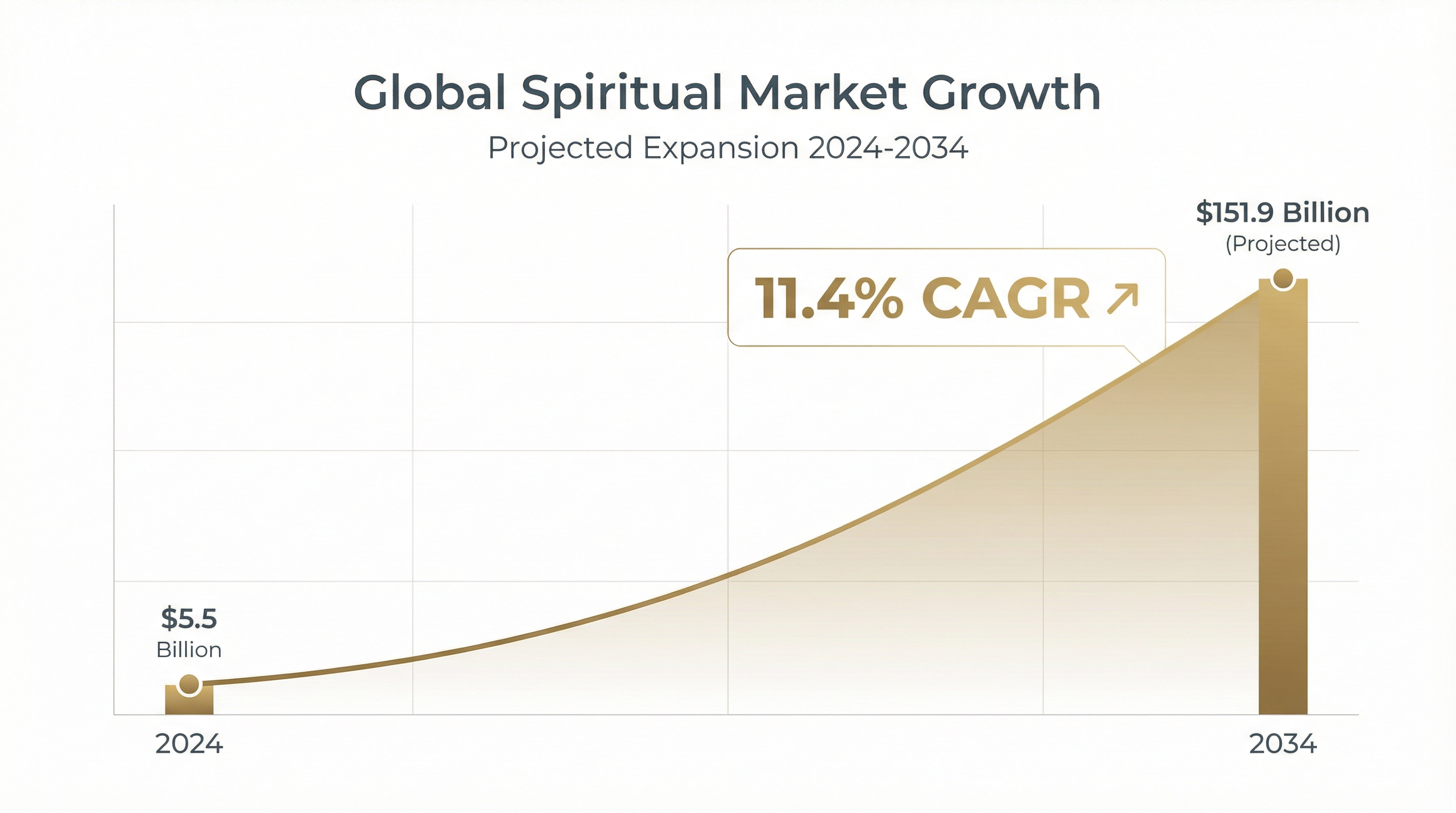
The global spiritual products market hit $5.5 billion in 2024. The size is the least interesting part for investors.
The interesting part is the growth rate: 11.4% annually through 2034. India's spiritual tech industry alone stands at $58.6 billion and is racing toward $151.9 billion by 2034, a 159% increase in a decade.
Spiritual wellness apps? They jumped from $2.16 billion to a projected $7.31 billion by 2033. Growth rate: 14.63% per year. That's outpacing traditional healthcare tech.
These numbers describe a full-scale investable sector emerging in real time. And the total addressable market is staggering.
Here's the investor insight that changes everything: 70% of U.S. adults describe themselves as spiritual. Twenty-two percent identify as spiritual but not religious. The decline of organized religion is creating a massive underserved market: seekers with smartphones, disposable income, and an unmet need that traditional institutions can't fill.
Blockchain Meets the Sacred: A New Asset Class
In August 2020, Bishop Sam Zuga launched Zuga Coin in Nigeria.
Africa's first cryptocurrency came from a bishop. It came from a religious leader, rather than a Silicon Valley founder or a Wall Street financier. A bishop who saw his community locked out of traditional wealth systems, and created a new investment vehicle to solve it.
He called it "an alternative means of wealth creation." The Nigerian government called him the "Envoy of Digital Economy" in 2022.
Temples in India now issue their own cryptocurrency for devotees to purchase and offer as donations. The blockchain provides transparent ledgers for religious transactions. You can track your offering from your wallet to the temple's charitable work. But here's what investors are noticing: these tokens have investment characteristics. They appreciate. They trade. They create returns.
This isn't theoretical. This is capital formation happening in real time.
The technology that promised to decentralize finance is now creating entirely new investable assets based on spiritual communities. And the implications stretch far beyond donation tracking, this is about alternative investments that blend faith-based communities with tokenomics.
What Happens When Faith Becomes an Investable Protocol?
Smart contracts can now automate tithing, and capture recurring revenue streams. Decentralized autonomous organizations (DAOs) can govern spiritual communities without hierarchical structures, and create governance tokens with market value. NFTs can represent membership in meditation circles or access to sacred texts, and trade on secondary markets.
From an investment perspective, this is extraordinary. Spiritual communities are becoming programmable economies with tokenized participation. The cash flows are transparent. The growth metrics are trackable. The exit liquidity exists.
Good or bad, venture capital is paying attention.
And the questions it raises don't have easy answers, especially when your LP returns depend on pricing enlightenment correctly.
AI-Guided Spirituality: The Scalability Play
In July 2025, Rgyan launched Bodhi in India.
India's first AI-powered devotional companion.
It offers personalized spiritual guidance. It learns your practice. It adapts to your questions. It provides the kind of one-on-one attention that human spiritual teachers can't scale, and that's exactly what makes it investable.
Here's the unit economics: A human spiritual teacher might serve dozens of students. An AI spiritual guide serves millions with near-zero marginal cost. The gross margins are extraordinary.
The concept of spiritual intelligence is gaining serious academic traction. Researchers describe it as "the capacity not only to think conceptually but also glean intuitively, akin to moral, aesthetic, social and emotional sensibilities."
Can AI develop spiritual intelligence? The question would have seemed absurd five years ago.
Today, venture capital is betting billions that the answer is yes, or at least, that consumers will pay subscription fees assuming it can.
But I keep coming back to a harder question for investors: Should we be allocating capital here?
The Loneliness Economy: An Investor's Perspective
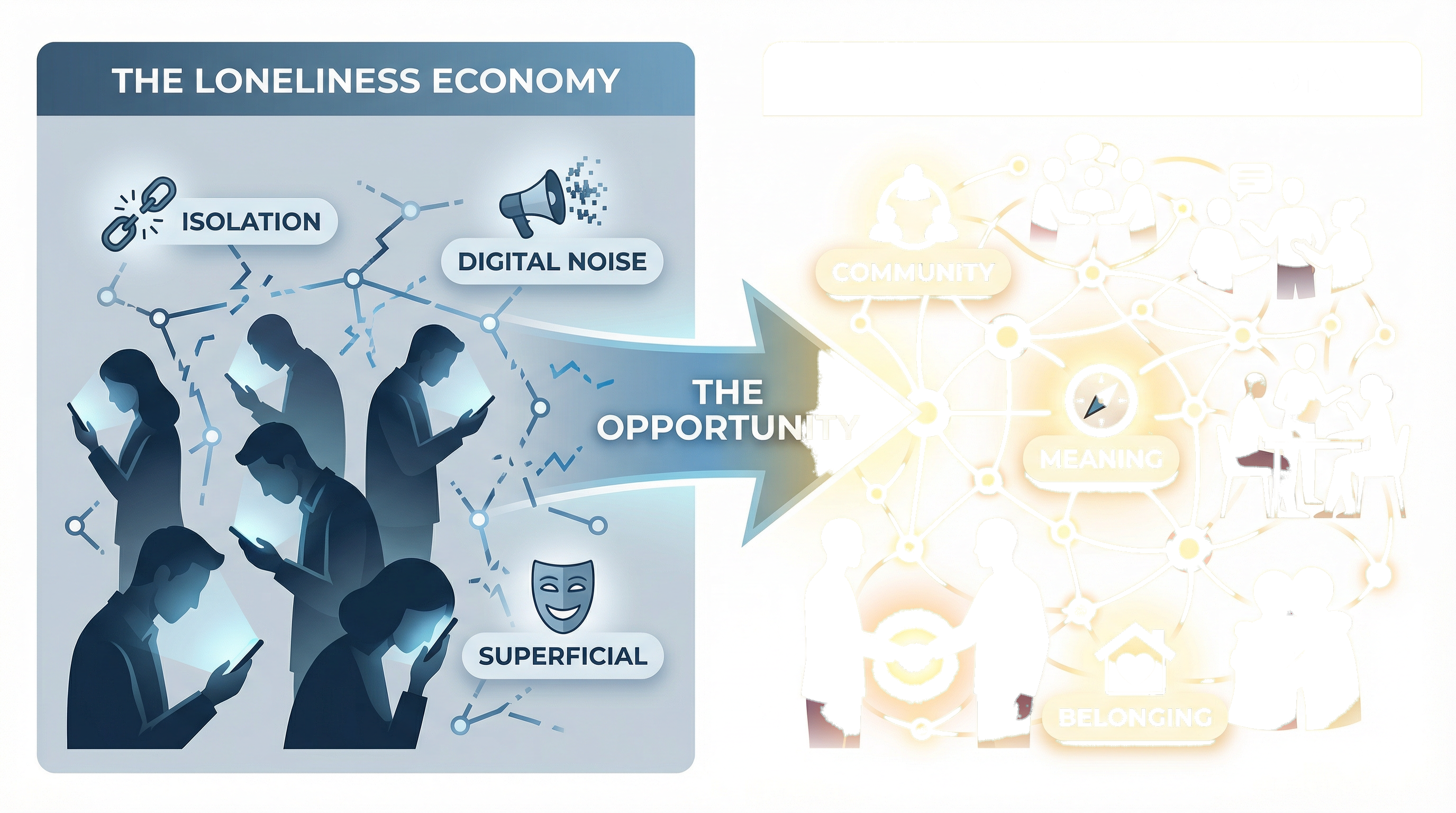
The World Health Organization calls loneliness a public health concern. Over one in five people worldwide feel lonely frequently. Experts predict this percentage will grow by 2030.
From an investing standpoint, that's a growing market with weak incumbents and high willingness to pay. Technology created part of this problem. Now technology promises to solve it with AI companions that never judge, never tire, never leave, and that require monthly subscription revenue.
Spiritual tech startups are building directly into this void. They've moved past meditation apps. They're selling connection, meaning, purpose. They're addressing fundamental human needs that have historically been served by free community institutions.
The market is responding. Hard. Capital is flowing to startups that can demonstrate engagement metrics in spiritual loneliness solutions.
The Millennial Spirituality Investment Opportunity
People aged 30-40 command over 35% of the spiritual products market.
This demographic shift reveals something crucial for investors: spirituality has become a premium lifestyle category with high customer lifetime value.
Millennials aren't joining churches, which have zero acquisition cost and rely on donations. They're buying crystals on Etsy. They're subscribing to meditation apps at $15-30/month. They're attending sound bath sessions in converted warehouses at $45 per session. They're hiring astrologers on Fiverr, creating marketplace transaction fees.
Every behavior shift away from traditional free spiritual services and toward paid spiritual products represents investable revenue.
Urban professionals use meditation aids and digital devotional apps to combat work stress. The high-income bracket demands ethically sourced, artisanal, luxury devotional products, creating premium pricing power.
Premiumization in spirituality is accelerating, and margin expansion follows.
You can now buy a $400 singing bowl made by Tibetan monks and have it delivered by Amazon Prime. The cognitive dissonance is the point. We want ancient wisdom with modern convenience, and investors want the margin between wholesale spiritual goods and premium retail pricing.
The Conscious Capital Paradox
The mindfulness industry is facing its relationship with investment capital head-on.
In the first half of 2024, the U.S. ESG market saw net outflows of over $13 billion. Political and cultural opposition to sustainable investing practices keeps growing. Meanwhile, spiritual tech startups are raising Series A rounds and promising venture returns.
This creates an investment tension that nobody has resolved: How do you generate LP returns from practices that traditionally rejected material accumulation? How do you sell spiritual liberation on a growth curve that demands 10x exits?
Buddhist teachers are hiring CFOs. Meditation apps are optimizing conversion funnels and CAC:LTV ratios. Yoga studios are running Facebook ads with ROAS targets.
The market demands growth. Spiritual practice demands detachment from outcomes.
These aren't compatible worldviews. But venture capital is forcing them together anyway, because the returns potential is too large to ignore.
What I'm Seeing as an Investor
I've spent months digging into this intersection, analyzing cap tables and talking to founders. Here's what stands out:
The market expansion thesis holds up. Technology is making spiritual practices accessible to people who would never walk into a temple or church, expanding the total addressable market exponentially. A rural teenager in Kansas can learn Vedic meditation from a teacher in Mumbai. That's powerful, and it's a previously untapped customer segment.
The commodification creates investable assets. When you can buy enlightenment on a subscription model, something fundamental shifts. The struggle becomes a product feature. The journey becomes a user experience. The spiritual path becomes a revenue stream with predictable MRR.
The authenticity question affects valuation multiples. Is an AI spiritual guide less authentic than a human one who's also getting paid? Is a blockchain-tracked donation more pure than an anonymous cash offering? These questions reveal assumptions we didn't know we had, and they directly impact how investors price these companies.
The Investment Reality Nobody Wants to Discuss
Global consumer technology spending is projected to reach $1,782.60 billion by 2030. That's a 6.6% annual growth rate.
Spirit-tech startups are capturing a growing slice of this spending. And they're doing it by solving problems, or at least what paying customers believe are problems.
People are lonely. People are stressed. People are searching for meaning in a world that feels increasingly meaningless. Each of these is a pain point. Each pain point has willingness to pay.
From an investment lens, the deciding factor is whether customers believe technology can solve existential problems, and whether they'll pay subscription fees on that belief. Sometimes, the perception is enough to build a billion-dollar company with sustainable unit economics.
This makes some investors uncomfortable. It should.
The Investment Questions That Matter Now
This convergence, good or bad, is inevitable. Capital is already flowing.
The pressing questions are about where to allocate:
Who gets to define what counts as authentic spiritual practice when it's mediated by technology and funded by venture capital? The teachers? The platforms? The users? The market? The cap table?
What happens to spiritual traditions when they're optimized for the engagement metrics that drive Series B valuations? When the algorithm rewards certain practices over others based on user retention and LTV:CAC ratios?
How do we preserve the transformative potential of spiritual practice while building venture-scale businesses? Can you scale enlightenment without destroying what makes it valuable, and if you can't, should investors care?
What fiduciary responsibilities do investors have when their portfolio companies aren't just building products but shaping spiritual lives? The stakes are higher than a failed exit. We're talking about funding systems that influence how people find meaning.
The Uncomfortable Truth for Investors
Investing, spirituality, and technology are converging because they solve for each other's limitations, and create massive returns potential.
Investment capital provides the resources to scale spiritual practice beyond traditional gatekeepers. Technology provides the distribution mechanisms to reach billions at near-zero marginal cost. Spirituality provides the meaning and purpose that create deep customer engagement and low churn.
This is an evolution of how humans have always related to the sacred, now with institutional capital backing and liquidity events.
Temples were always funded. Spiritual teachers were always supported. Sacred texts were always copied and distributed using the best available technology.
What's different now is the speed, scale, and return expectations. Donors gave without expecting ROI. Investors demand it.
Where Capital Flows Next
I see three investment scenarios, and we're probably seeing all of them simultaneously across different market segments:
Scenario One: Full Platform Integration. Spiritual practice becomes another feature in the attention economy, and the super-app play. Your meditation app talks to your fitness tracker talks to your therapy app talks to your financial wellness platform. Everything is optimized, measured, improved. Winner-take-most dynamics emerge. Expect M&A consolidation and strategic acquirers paying premium multiples for spiritual engagement data.
Scenario Two: Market Correction. People recognize the limitations of commodified spirituality and return to traditional, unmediated practices. The pendulum swings back. Growth slows. Burn rates become unsustainable. Down rounds happen. The market corrects, and only companies with actual unit economics survive.
Scenario Three: Sustainable Hybrid Models. We figure out how to use technology to support spiritual practice without replacing the essential human elements. The tools serve the practice instead of defining it. These companies grow slower but build defensible moats through authentic community. They grow into profitable, fundable businesses without needing unicorn trajectories.
My bet? We'll see all three happening in different market segments at different speeds. Smart investors will understand which category each company falls into.
What This Means for Your Portfolio
If you're investing in this space, you're shaping how millions of people relate to meaning, purpose, and the sacred.
That's a responsibility you can't optimize away, and it comes with fiduciary implications.
If you're building in this space, you're asking investors to bet on your ability to monetize fundamental human needs that have historically been served outside market mechanisms.
That's a harder pitch than SaaS metrics alone can support.
If you're watching from the sidelines as an allocator, you're seeing a new asset class emerge. The intersection of investing, spirituality, and technology is a fundamental restructuring of how capital flows toward meaning.
The temple started accepting crypto. The guru launched a venture-backed app. The blockchain recorded your prayers and created tradable tokens.
This is where we are.
Whether this should be happening is settled. Capital has already decided. The question is whether you understand the sector well enough to invest intelligently, and whether you're comfortable with the ethical implications of the returns.
This article is general education. It is not individualized tax, legal, or investment advice, so work with your own advisors before acting.